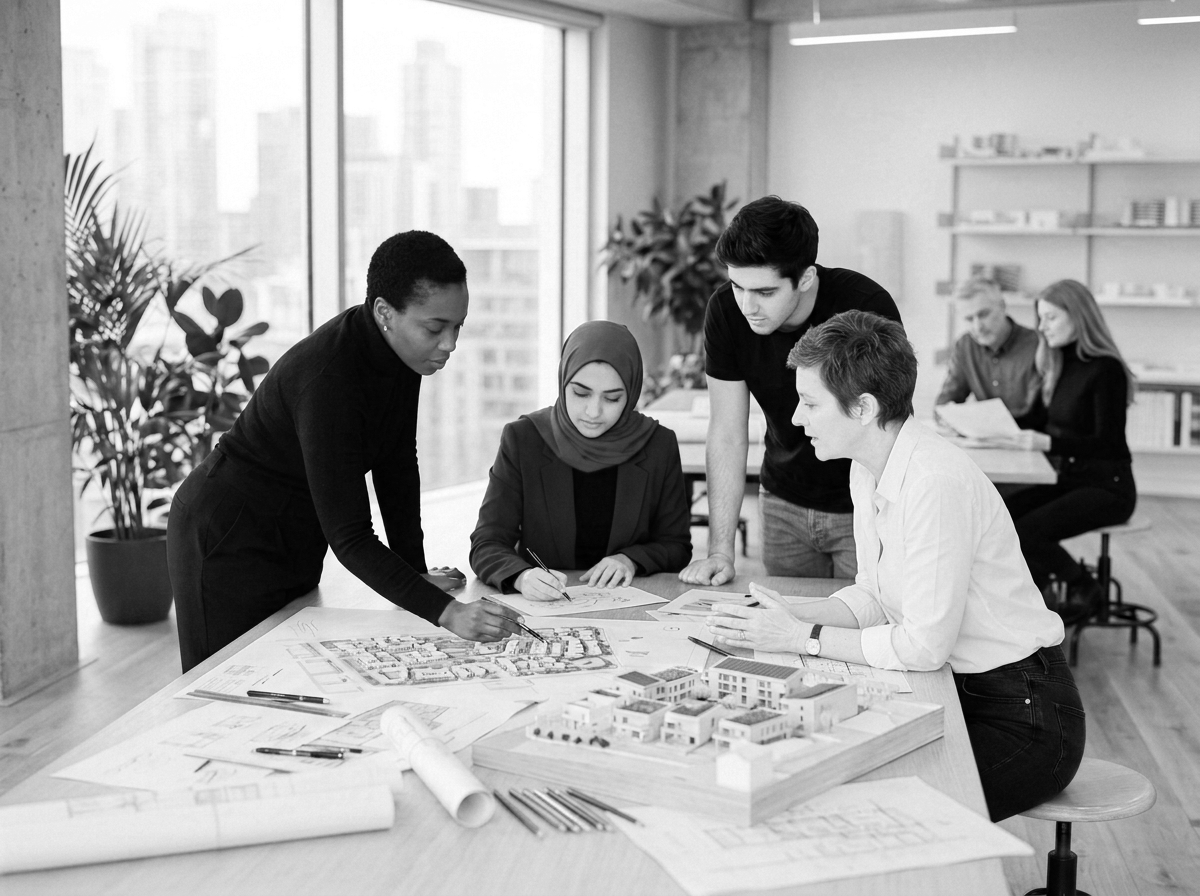
How It worksThree identities. Four stages. One methodology, held from the first question to the last decision.
Diagnose
The brief begins with what we call "mess-finding". We take the project apart to uncover the unstated assumptions about who will use the space, what land it sits on, and what it will cost the systems around it. This is where discrimination by design and extractive thinking are called out.
The most comprehensive design brief possible, never just for a default user
Map ecological and social externalities
Identify heritage, context, and precedent the site already holds
Define what "success" must include, not just what it must avoid
The question we ask before any design begins: “What is this brief assuming, and who and what does that assumption exclude?”
Design — Making Invisible Visible
We see each site not as land upon which architecture should be placed, but as a system of forces from which architecture can emerge.
We arrive at each project as a people first, designers second. Landscape often appears still, yet its form is the consequence of extraordinary energy, eruption, cooling, pressure, erosion, heat, and time.
Does this serve every body, every life, and every system it touches?
This is where equity of experience becomes design concept. This is where human and earth systems become interconnected design parameters. We identify where intervention has the greatest value and least environmental and human cost. Universal design and regenerative principles are drawn from the brief's findings, not from predetermined stylistic ideas.
Design holistically for the full range of human sensory and physical experience
Design within planetary boundaries — energy, water, biodiversity, climate
Treat land as stewardship, not extraction, from the first drawing
Stress-test the concept against the exclusions named in Diagnose
Develop — Making Visible Possible
Reinventing what we already know is wasted time no project can afford.
Local knowledge is integrated, allowing tradition to influence construction logic and material systems. Craft shapes structural decisions rather than finishing them.
Our ambition is not only to minimise impact at the moment of construction, but to ask whether the architecture and design can actively improve conditions over time, supporting water conservation, ecological recovery, climatic comfort, and responsible access.
What already solved part of this — and who else needs to be in the room?
Development is where the concept becomes buildable, and where we refuse to let disciplines work in silos. We bring architecture into conversation with ecology, engineering, and community knowledge, and we bring heritage and craft into conversation with modern technical delivery.
Coordinate multidisciplinary technical development — structural, mechanical, environmental
Develop the whole design as one spatial and experiential system, not a set of separate project components
Integrate heritage and local craft knowledge into modern technical systems
Manage RIBA stages documentation, budgets, and contractor coordination
Hold every technical decision to the same standard set in Diagnose and Design
Test each design iteration against environmental performance, universal accessibility, operational feasibility, and long-term adaptability

Deliver — Making Possible Adaptable
Does this building still hold the decision it started with, once we are no longer in the room?
Delivery is not the finish line where standards relax. It is the last, hardest test of whether they hold. We stay accountable through construction, commissioning, and handover, and we make sure the people who will run, inhabit, and maintain the space are equipped with the knowledge to carry it forward as intended.
Lead Designer (CDM) and Contract Administrator accountability through completion
Monitor construction against programme, budget, and original intent
Equip occupants, operators, and teams with the knowledge to sustain the design's intent
Measure delivery against the exclusions and externalities named at Diagnose
“I was worried and frustrated and didn’t trust my choice. Suzanne took away the fear and the frustration, I understood and learnt to trust my decisions.”
— Client“Suzanne has never lost a planning application. She has a hundred percent success rate. Now I understand why.”
— Client“Team has such a refreshing and unique approach to design – always looking for new concepts and ideas. They are using tried and tested manufacturers for their developments. Their projects are always leading edge concepts using beautiful products. Great pleasure to work with them.”
— Collaborative Project Partner“They do not build for mainstream ambitions; they design for human flourishing and planetary survival. They will challenge your way of thinking.
— Development Project Partner